Products & Equipment I Use
My real working setup built on tools I actually use every day
This is my real, working setup. No brand hype, no gear collecting. Just tools that earn their place through consistent use.
I don't chase new releases or upgrade for the sake of upgrading. Every piece of equipment listed here solves a specific problem, works reliably under pressure, and stays out of the way so I can focus on the work itself. Some of this gear is years old. Some of it isn't the newest model. None of that matters—what matters is whether it still does the job well.
What follows isn't comprehensive. It's honest. If it's here, I use it regularly. If I stopped using something or found it unreliable, it's not listed. This is the actual inventory that moves between sessions, projects, and workspaces, not an aspirational gear list or a sponsored showcase.
Cameras
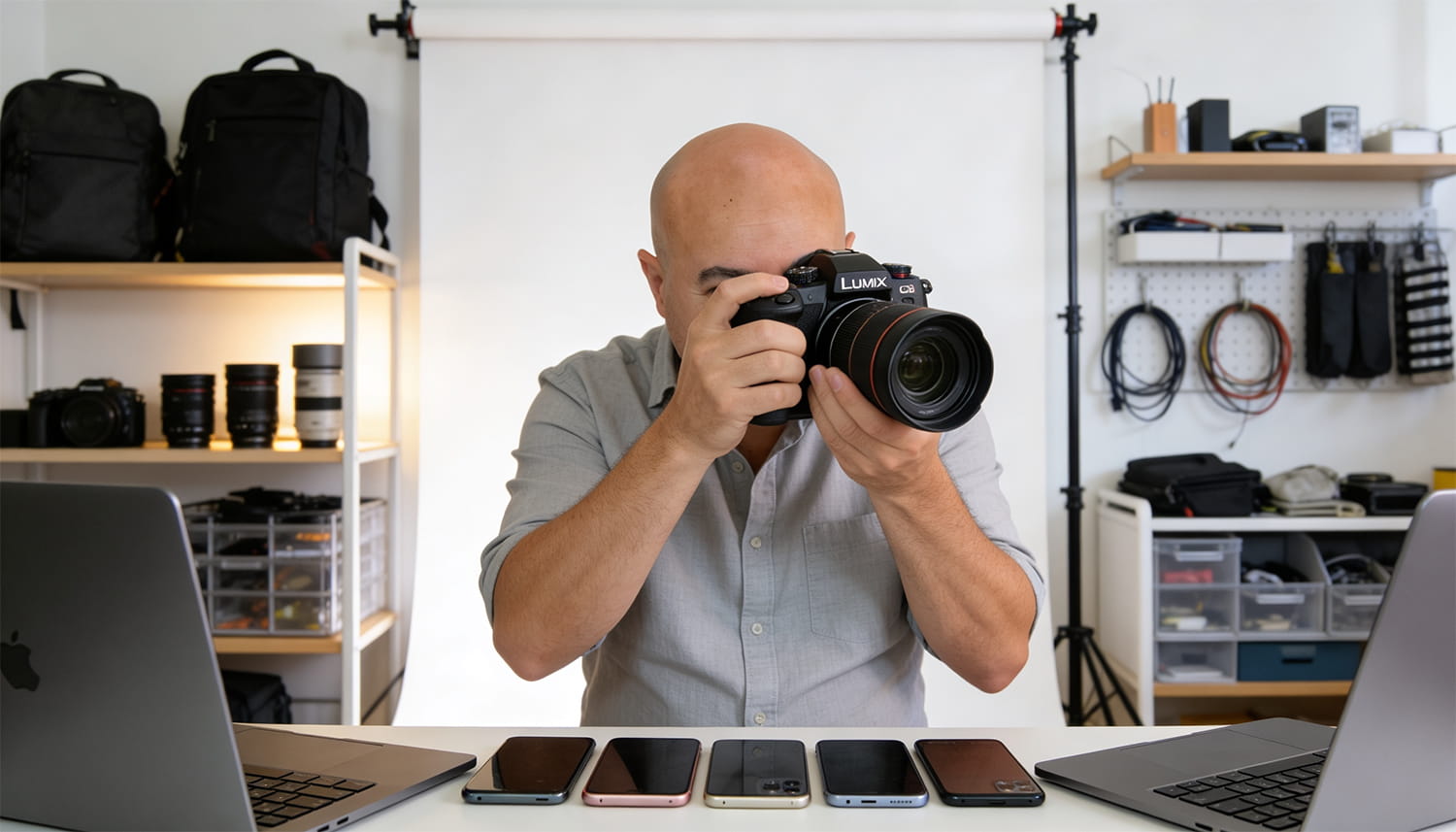
Canon Full-Frame Camera Systems
Used for photography and people-focused work where color accuracy, reliability, and image quality matter.
Canon's full-frame bodies handle everything from studio portraits to outdoor family sessions. The color science is predictable, the autofocus is dependable, and the systems are mature enough that I'm not troubleshooting mid-session. These cameras disappear into the workflow, which is exactly what I need.
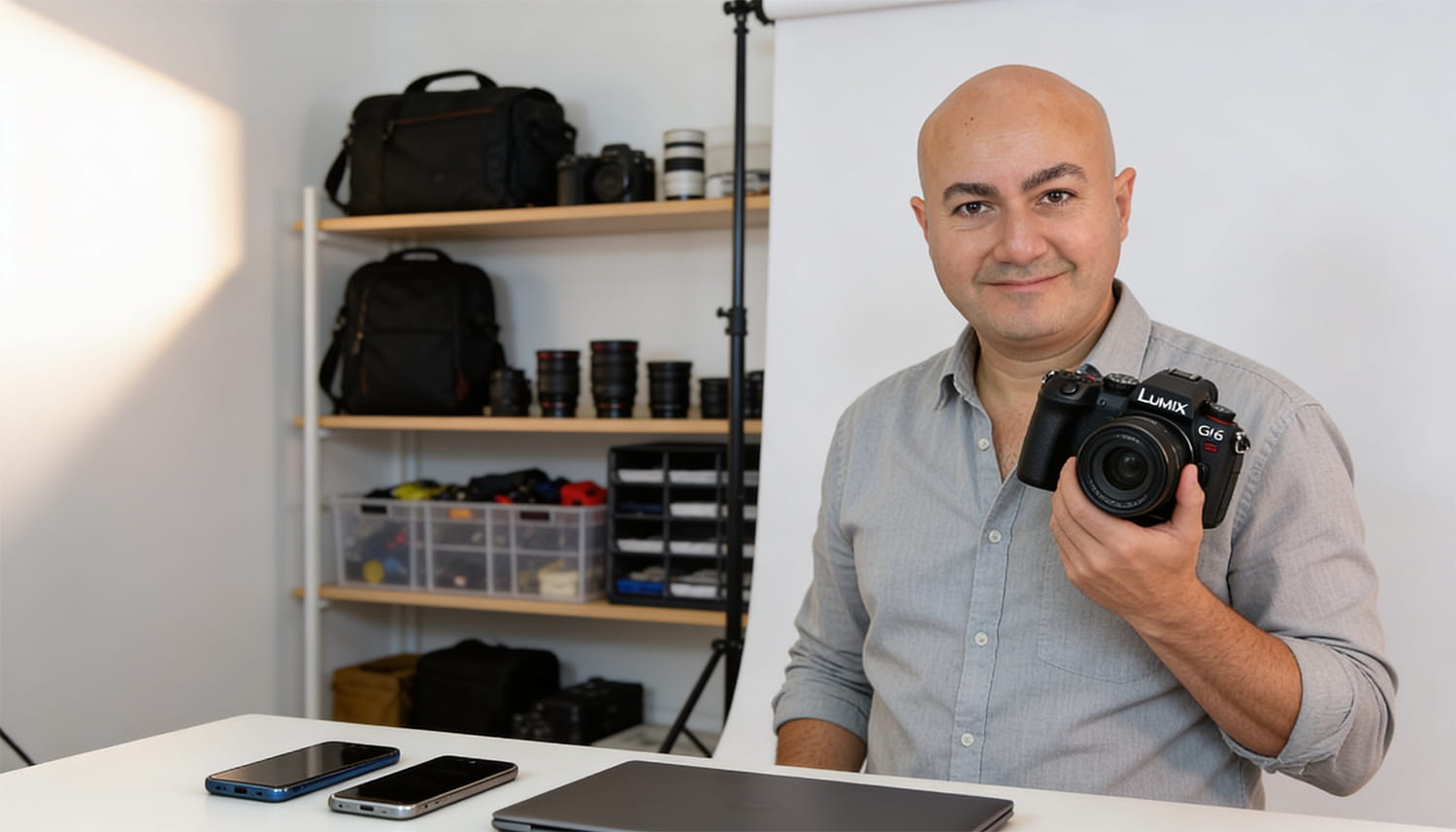
Panasonic Lumix GH6
My hybrid video camera. Reliable, flexible, and well-suited for controlled production and motion work.
The GH6 handles video production where durability, recording flexibility, and heat management matter. It's not the flashiest camera on the market, but it works consistently in longer recording scenarios without overheating or dropping frames. Built for work, not for showing off.
Samsung Galaxy S25 Ultra
A smartphone camera that handles professional scenarios when a full setup isn't practical.
The S26 Ultra's quad-camera system (200MP main sensor, ultra-wide, telephoto array) produces images that hold up in client contexts. Computational photography compensates for most lighting challenges. It's the always-present backup, the scouting tool before bringing dedicated gear, and increasingly the primary choice for quick documentation and social content.
Lenses
Prime Lenses
For portraits and natural depth.
Primes deliver sharpness and shallow depth of field that make portraits feel dimensional rather than flat. Fixed focal lengths also force compositional discipline. You move to frame the shot rather than zooming. I reach for primes when the subject and environment allow deliberate composition.
Zoom Lenses
For flexibility and fast-paced sessions.
Zooms handle situations where positioning is constrained or moments are unpredictable: family sessions with active kids, events, documentary-style work. The trade-off in maximum aperture is worth the flexibility when you can't control every variable.
How I Choose Lenses
Lenses are chosen for consistent rendering and reliable performance, not specs on paper. A lens that performs predictably across varied lighting and distances is more valuable than one that tests perfectly in controlled conditions but behaves inconsistently in real use.
Lighting
Continuous Lighting
For natural, calm setups where seeing the light in real-time matters.
Continuous lights let you see exactly what you're capturing before you press the shutter. They create calm sessions: no sudden flashes that startle children or pets. I use them when the environment allows control and the goal is natural-feeling light.
Studio Lighting (Strobes)
For precision, power, and repeatability.
Strobes deliver consistent output, freeze motion, and overpower ambient light when needed. Studio work, product photography, and situations requiring exact reproducibility: this is where strobes earn their complexity.
Light Modifiers
Softboxes, diffusion panels, reflectors, and grids.
Light modifiers shape how light falls and wraps around subjects. A softbox creates gentle, flattering light for portraits. A reflector bounces fill light into shadows. Grids focus light precisely. The modifier often matters more than the light source itself.
Lighting Philosophy
Lighting is always shaped to feel natural, not staged. Even in controlled studio environments, the goal is to make light look like it belongs, like it could have existed without intervention. Technical precision in service of natural results.
Stabilization & Support
Tripods & Monopods
Essential support gear for static shots, long exposures, and controlled compositions.
A solid tripod removes camera shake from the equation entirely. Critical for low-light work, precise framing, and anything requiring consistency across multiple shots. Monopods add stability while keeping mobility for events, outdoor sessions, and situations where a full tripod setup isn't practical. Unglamorous gear that makes everything else work better.
Gimbals — Zhiyun Weebill S & Smooth 4
Motorized stabilization for smooth handheld video—camera and mobile.
The Zhiyun Weebill S handles the GH6 for cinematic movement without the weight of traditional stabilizers. The Smooth 4 does the same for the Galaxy S26, turning smartphone footage into something that doesn't look handheld. Both are 3-axis systems that compensate for shake in real time, making walkthrough videos, product demonstrations, and dynamic B-roll actually usable.
Camera Slider — KONOVA KMS S2
Motorized slider for controlled camera movement and precision timelapse work.
The KONOVA KMS S2 adds programmed motion to static shots: slow horizontal slides, repeatable camera moves, and smooth timelapse sequences that would be impossible handheld. Live motion control means the slider can execute complex moves during recording, and timelapse mode handles long-duration sequences with consistent incremental movement. Small enough to be portable, precise enough for professional results.
Workflow & Control Tools
Elgato Stream Deck (Classic)
Used to trigger shortcuts, actions, and production workflows.
The Stream Deck replaces multi-step keyboard shortcuts with single button presses. It controls software, triggers automations, switches scenes, and executes complex workflows instantly. Small efficiency gains compound across hundreds of actions per day.
Elgato Stream Deck +
Dedicated control surface for larger workflows, automation, and system control.
The XL provides more buttons for more complex workflows: production environments where multiple applications, cameras, and automations need instant access. It's particularly valuable in hybrid workflows where photography, video, and live production converge.
Why Control Surfaces Matter
These tools reduce friction and speed up repetitive tasks. Every action that moves from "remember keyboard shortcut" to "press button" removes cognitive load and makes workflows more sustainable over long sessions.
Editing & Production Environment
Color-Accurate Displays
Calibrated monitors that represent images as they'll actually appear.
Color accuracy isn't optional in professional photography. Displays are calibrated regularly to ensure what I see during editing matches what prints, what displays on client screens, and what appears across different devices.
High-Performance Editing Workstation
Fast processors, ample RAM, and GPU acceleration for photo and video editing.
Photo editing, especially with high-resolution files and complex layer stacks, demands computing power. Video editing even more so. The workstation is built to handle 4K timelines, batch processing hundreds of images, and running multiple applications simultaneously without slowdowns.
Structured Storage and Backups
Redundant storage, automated backups, and organized file systems.
Client work, personal projects, and archival photography require reliable storage infrastructure. Automated backup systems ensure nothing is lost to drive failure. Organized file structures mean projects from years ago remain accessible and usable.
Production Environment Philosophy
The editing environment supports photography, video, and automation workflows without becoming the focus. Good infrastructure is invisible. It just works, consistently, so attention stays on the creative and strategic decisions that actually matter.
How I Choose Gear
I don't chase new releases. I choose tools that are reliable under pressure, easy to live with long-term, and quiet in use while delivering strong results.
Gear culture rewards constant upgrades and spec comparisons. That's not how I work. A camera that performs consistently across three years of varied shoots is more valuable than one that tests 5% better in controlled conditions but behaves unpredictably in real use.
If a piece of equipment is listed here, it's because I use it regularly, trust it when it matters, and would choose it again knowing what I know now. That's the only endorsement that means anything.
What's missing from this list is just as telling as what's included. I've tried and moved on from plenty of gear that looked good on paper but didn't serve real work.